


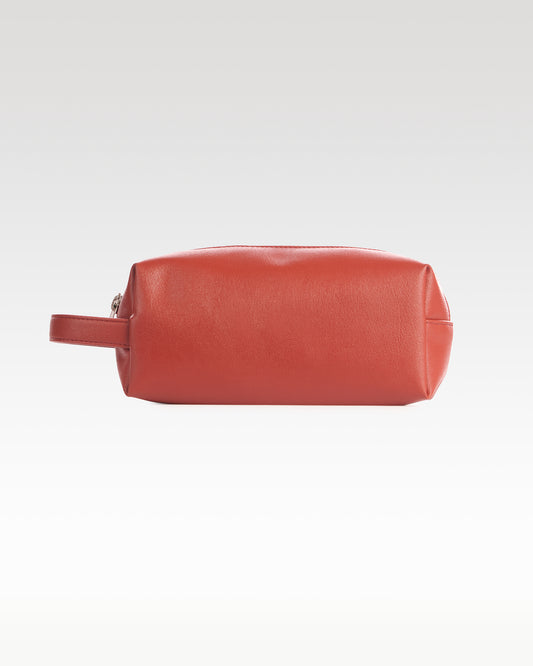
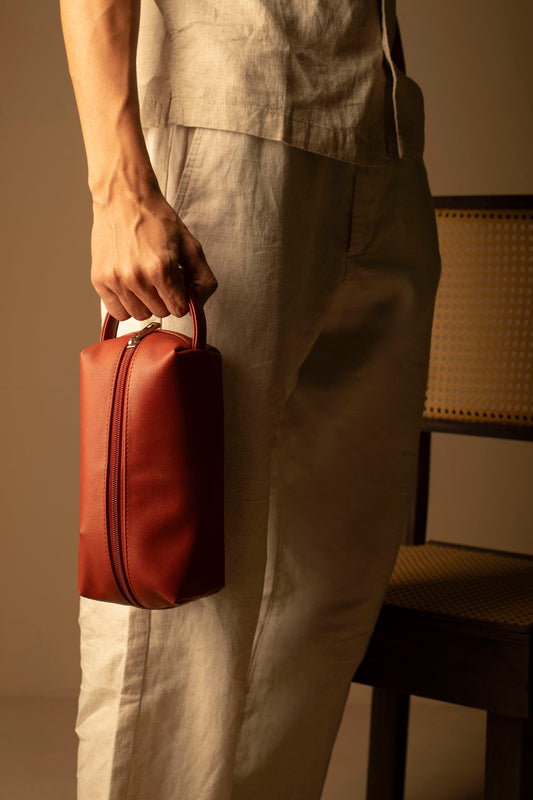


Every leather brand publishes a care guide. The language is usually some version of: avoid heavy rain, avoid direct sunlight, store in the provided dust bag, apply conditioner regularly, and treat scratches as evidence of character rather than a problem the brand is responsible for.
This is not criticism. Leather genuinely requires all of that. It is a natural material with natural limitations - it absorbs water, it stiffens when it dries unevenly, it needs oil worked back into it periodically to stay supple, and it is genuinely sensitive to sustained heat and UV exposure. The care instructions are honest.
Plant-based leather care instructions are shorter. That is the point.
What the material actually needs
A damp cloth. That is the primary cleaning method for plant-based leather in normal use. Wipe the surface, let it dry, done.
For surface scuffs or more stubborn marks, a slightly more damp cloth with a tiny amount of mild soap handles almost everything. Wipe once with the soap solution, then once with a clean damp cloth to remove any residue, then let it dry in air. No product required, no technique to learn.
The surface of plant-based leather does not absorb cleaning agents the way animal leather absorbs conditioner. This is an advantage, not a limitation. You cannot accidentally over-condition it. You cannot apply the wrong product and dry out the fibres. You wipe it and it is clean.
What it does not need
No conditioner. The polymer surface does not absorb conditioning products, and applying them does nothing useful. Some conditioning products marketed for vegan leather may temporarily change the surface appearance, but this is a surface deposit, not absorption, and it does not improve the material's performance or longevity.
No dust bag for storage. Leather bags are stored in dust bags partly to prevent light exposure and partly to prevent the hide from being compressed or creased while stored. Plant-based leather does not have these sensitivities. Leave it on a shelf.
No sunlight anxiety in the same way. Prolonged direct exposure to very intense sunlight over months is not good for any material, but the calibration is different. Leaving a plant-based leather bag near a window that gets afternoon sun is not an emergency.
No polish. The surface does not take shoe polish or leather polish and does not benefit from it.
Monsoon specifics
The monsoon creates two practical challenges: high surface humidity for months at a time, and the specific problem of wet bags from commuting in rain.
After the bag gets wet in rain, shake off the standing water and open it fully to let air circulate inside. The fabric inside the bag needs to dry just as much as the exterior material. Do not close and re-pack a damp bag. Do not leave it in a closed room. A ventilated space - near an open window, under a fan - dries it in an hour or two.
The issue is not the wet surface. It is storing a damp bag in a humid, unventilated space for days. That is how interior fabric develops a smell. It is also how sustained humidity creates the conditions for slow material degradation over time. Dry it fully, then store it.
Summer heat and closed cars
This is the one to take seriously. Interior car temperatures in Indian summer can reach well above what any coated material is designed to handle. Sustained high heat in a closed car accelerates the hydrolysis process that degrades polymer coatings over time, and can cause surface cracking in severe cases.
Do not leave the bag in a parked car in peak summer heat. This applies equally to leather bags, which can crack and dry out severely under the same conditions. It is not a plant-based leather weakness specifically - it is physics applied to any coated material.
Storage between seasons
No special ritual required. A dry, airy shelf is ideal. Avoid sealed plastic bags for long-term storage - the lack of air circulation in a sealed environment combined with residual moisture creates exactly the conditions the material does not want.
Do not store the bag compressed under heavy weight for months. Not because plant-based leather is delicate, but because any structured bag can take a set under sustained compression, and that is harder to reverse than preventing it.
What will actually damage it
Sharp abrasion damages the top coat. A key scraped repeatedly across the surface, or a bag shoved under a car seat next to something abrasive, will eventually scratch through the surface coating.
Solvents damage the polymer coatings. Acetone, nail polish remover, alcohol-based cleaners used neat - any of these can degrade the surface. If you need to remove something from the surface, start with a damp cloth, then a tiny amount of dish soap. Test on an inconspicuous area before using anything stronger.
Prolonged folding under weight degrades a structured bag over time. Do not store a bag fully loaded and compressed under other bags for months.
Our guide to whether plant-based leather is waterproof covers the monsoon rain scenario in more detail. For the full vocabulary of what makes plant-based leather different, our guide to what the labels actually mean is the most complete reference.
The Dune Shoulder Bag and the Traveller Passport Case are both designed for regular daily use and see the full range of Indian weather. Either is a practical test of the care routine described here.
RebagCo. offers 14-day free returns. Use the first two weeks in your actual conditions - rain, sun, commute, storage - and return it if it is not right.