


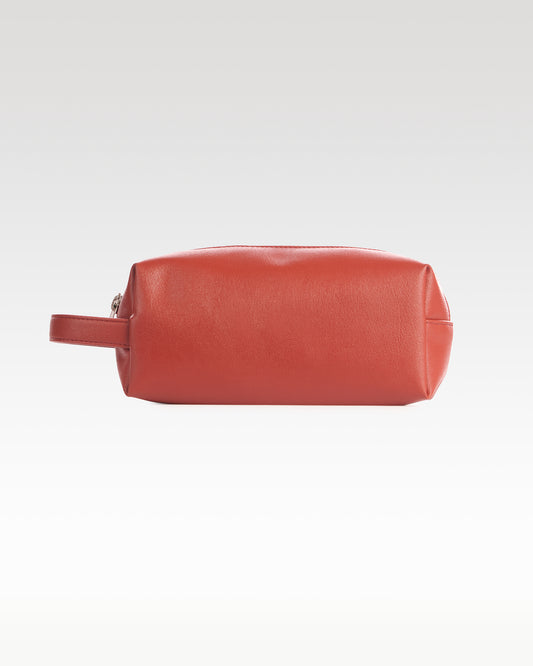



The assumption most people carry into this category is that price is mostly a function of material cost. Leather is expensive because hide is expensive. Plant-based leather should be cheaper because plant fibre is cheaper. A bag that costs significantly more than a fast-fashion alternative is charging a premium for branding.
This reasoning is wrong in its structure, and understanding why gives you a much more accurate model for judging whether a price is justified.
Raw material is a smaller share of cost than you assume
Material cost is one input among several, and it is not usually the largest. Consider what a bag costs to produce before it reaches a showroom or a shipping box.
Pattern development: a designer and a pattern maker working through multiple iterations to produce a shape that works structurally, holds its form under load, and looks right at each size. This is not a one-time cost that disappears after the first run - it is a fixed cost spread across the production volume. For small-run brands, this fixed cost lands hard on each unit.
Hardware sourcing: zips, buckles, D-rings, rivets, clasps. Quality hardware is sourced from specific suppliers, often with minimum order quantities. YKK zips, cast brass hardware, and quality buckles are not interchangeable with unbranded alternatives at the same cost. The hardware in a well-made bag may account for more of the total product cost than the material itself.
Stitching and assembly time: this is the largest variable cost in bag production. Sewing a bag with consistent stitch density, clean seam finishing, edge painting and bar-tacked reinforcement at stress points takes time. Time costs money. A bag assembled in two hours by a skilled machinist costs more per unit than a bag assembled in thirty minutes by a less experienced one. The stitching quality you can see on a finished product is a direct reflection of the time invested.
Quality control: every unit that fails inspection before shipping is a cost. A manufacturer with a meaningful QC process and a meaningful rejection rate is spending money to ensure the units that ship meet a standard. That cost is in the price of every unit that does pass.
Why a cheap PU bag is cheap
A bag sold at a very low price is built to that price. The material is a thin scrim with a minimal coating - the cheapest construction in the category. The hardware is unbranded, cast with lower quality alloys, and not tested for cycle life. The stitching is fast, not careful. Edge finishing is skipped entirely - raw edges are left raw. QC is minimal.
This is not necessarily dishonest. A bag built to last a year and priced accordingly is coherent. The problem arises when that bag is described with the same vocabulary as a product built to last five. The construction is not comparable. The price reflects the construction.
Why small production runs cost more per unit
Volume drives manufacturing economics in one direction: down. A brand producing 10,000 units of a bag spreads its pattern development cost across 10,000 units. It negotiates volume pricing on hardware. Its machinists are faster at the specific seams in that pattern from repetition. Its material is cut with less waste relative to volume. Every fixed and semi-fixed cost becomes a smaller fraction of the per-unit price.
A brand producing 200 units of the same bag spreads its pattern development cost across 200 units. It cannot negotiate the same hardware pricing. Its machinists may be just as skilled but less fast. Material cutting is less optimised. The per-unit cost is higher, structurally, regardless of the intentions or efficiency of the brand.
This is why small, quality-focused brands cannot match the per-unit cost of large fast-fashion brands even when they use better materials and better construction. The economics work against it. The premium they charge is not entirely margin - a significant fraction is the structural cost of small-volume production.
What you are actually paying for at the premium end
A premium plant-based leather bag is priced to cover: a material with a substantive fibre base and hydrolysis-resistant bio-PU coating, sourced from a supplier that has run performance testing on it; hardware from named suppliers with documented quality; stitching time at a density and consistency level that requires skill and pace; edge finishing that requires multiple coats of paint applied carefully; reinforcement at every structural stress point; quality control that catches failures before they ship; and the amortised cost of a design process that worked out the shape properly before cutting material.
The question is not whether the premium exists. It is whether the specific product justifies it.
How to judge whether a price is justified
Start with the construction inspection covered in our how to tell if a bag is well made guide. If the construction checks out - good hardware, clean stitching, bar tacking at stress points, proper edge finishing - the price is likely reflecting real production cost. If the construction does not check out, the price may be reflecting branding rather than building.
Ask about the material specifically. A brand that can describe its base layer, its polymer type and its performance testing has spent money on material quality and knows what it bought. A brand that describes only the surface finish may not have.
Look at the hardware. YKK zips, cast brass fittings with no visible weld cracks, rivets that sit flush - these are not expensive add-ons at the production level. They are the standard for any manufacturer producing at a quality level worth paying for. Their absence is a meaningful signal.
Consider warranty coverage. A brand confident in its product offers meaningful warranty coverage against manufacturing defects. A brand that does not offer this, or offers a very short window, is communicating something about its confidence in the product's durability.
If you are working out whether a specific price point represents good value, the comparison between plant-based and leather alternatives is worth making with full information - our guide to plant-based leather versus genuine leather runs that comparison across the variables that actually matter in a purchase decision.
For understanding what you are paying for in material terms - what bio-based content percentages mean, what the layers inside the material do, and what polymer content is and is not a problem - our guide to what the labels actually mean is where to start.
The Classic Requirement Backpack and Dune Shoulder Bag represent the point where material quality, hardware and construction discipline all need to be present simultaneously to justify the form. They are worth inspecting in hand with the construction checklist in mind.
RebagCo. offers 14-day free returns. A price is only worth paying if you are confident after using the product. The return window removes the risk of finding out you were not.